MTCIPv6E92%Active
MikroTik Certified IPv6 Engineer
Valid May 2025 – May 2028 · Verify on mikrotik.com
I extend network addressing to IPv6, future-proofing infrastructure while maintaining full dual-stack connectivity through the transition.
What This Certification Validates
DHCPv6, SLAAC, prefix delegation, and transition tunnels — dual-stack designed so IPv4 reachability never breaks.
- ·IPv6 addressing & subnetting
- ·SLAAC (Stateless Address Autoconfiguration)
- ·DHCPv6 server & client
- ·Dual-stack configuration
- ·IPv6 tunneling (6to4, 6rd, ISATAP)
- ·IPv6 firewall (filter + mangle)
- ·IPv6 routing (OSPFv3, BGP)
- ·Neighbor Discovery Protocol
- ·IPv6 prefix delegation
- ·Transition mechanisms
MTCIPv6E vs Generic IPv6 training (no widely recognized cert)
| Dimension | MTCIPv6E | Generic IPv6 training (no widely recognized cert) |
|---|---|---|
| Scope | IPv6 on RouterOS: addressing, routing, firewall, transition | IPv6 theory + multi-vendor config |
| Vendor lock-in | MikroTik only | Vendor-neutral |
| Hands-on depth | Full dual-stack deployment on real RouterOS | Varies |
| Renewal cycle | 3 years, re-exam | Often no renewal required |
| Relevance | Growing — IPv4 exhaustion accelerating | Growing |
Certification combinations
MTCIPv6E combines with these certifications.
Case studies
Anonymized engagements demonstrating this expertise.
Case #1
- Situation
- ISP needed to deploy IPv6 for residential customers while maintaining full IPv4 connectivity.
- Challenge
- Legacy CPE devices, upstream provider's IPv6 prefix delegation quirks, and customers running IPv4-only services that couldn't break.
- Methodology
- Dual-stack deployment with DHCPv6-PD for customer prefix delegation, SLAAC for LAN clients, IPv6 firewall mirroring IPv4 security policy, 6rd tunnel as fallback for legacy segments.
- Result
- 60% of subscribers IPv6-enabled within 3 months. Zero IPv4 service disruption. IPv6 traffic grew to 35% of total within 6 months.
Exam details
Exam format and certification details
- Format
- 25 multiple-choice questions, open-book
- Pass score
- 60%
- Duration
- 60 minutes
- Prerequisite
- MTCNA (can be expired for recertification)
- Training
- 2 days
- Validity
- 3 years
- Global rarity
- ~200–500 active holders
- RouterOS ver.
- RouterOS v7
Score history
Score progression across certification cycles
2019Kuala Lumpur
2025Bangkok
Training providers: Citraweb (ID), MikroTik SEA
Certificate
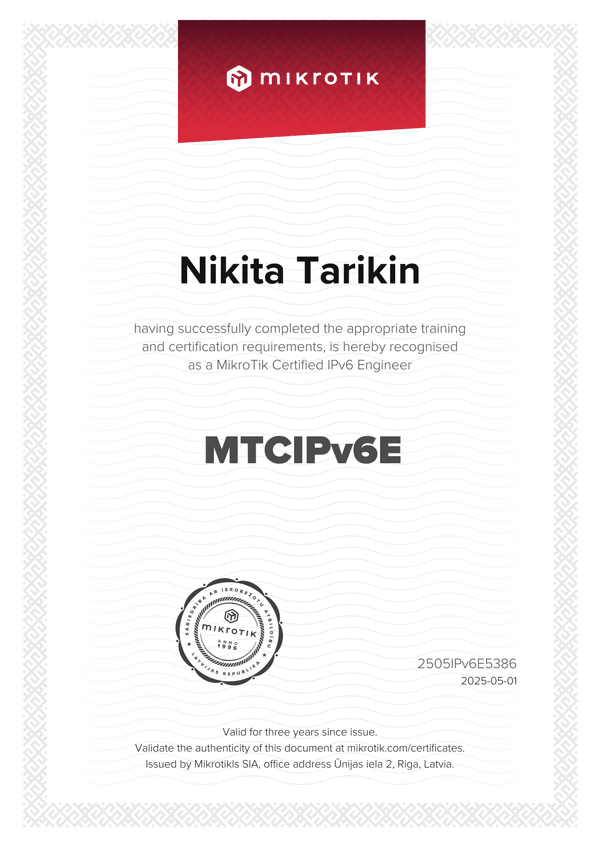
Click to enlarge
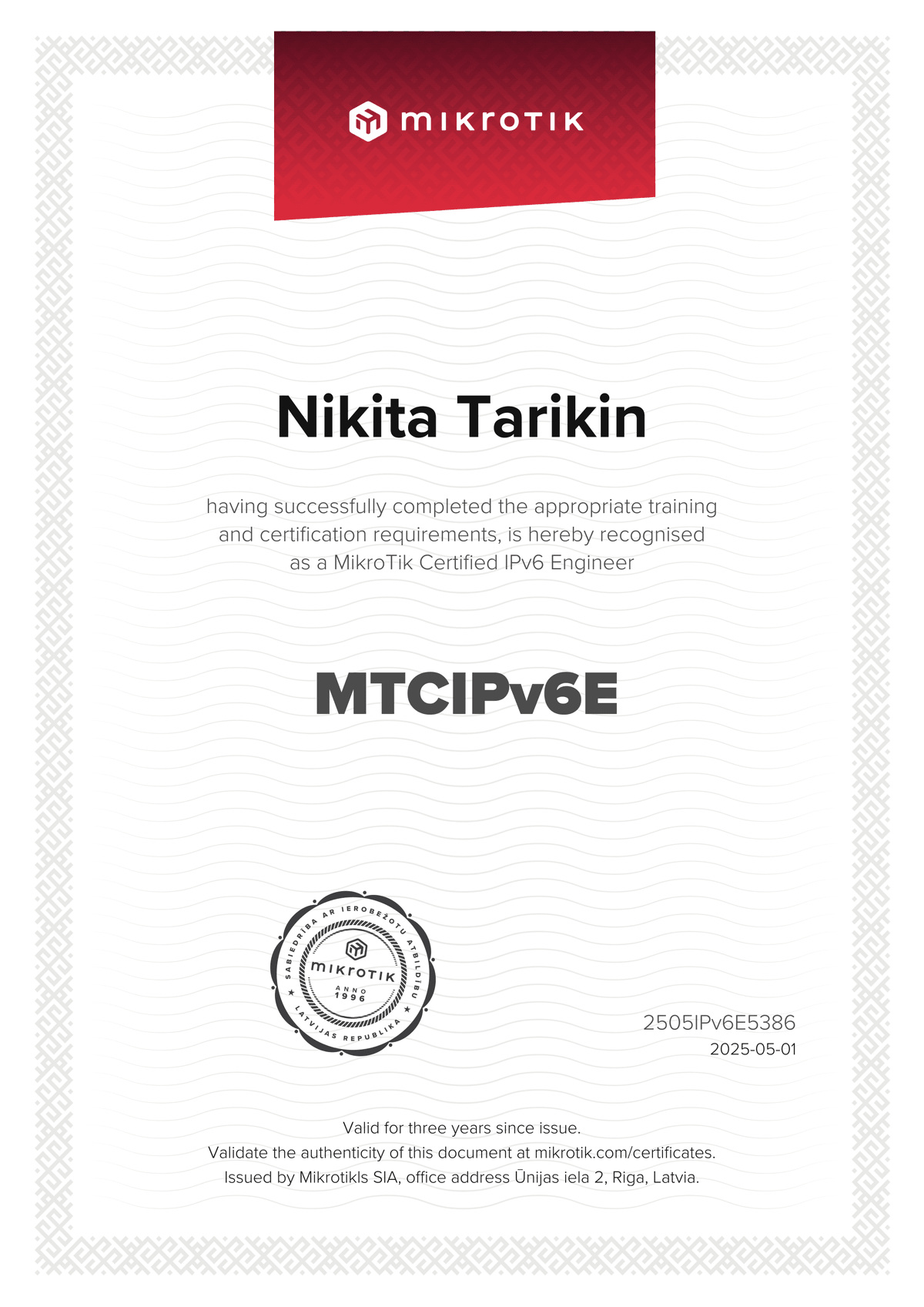
FAQ
What does MTCIPv6E certification cover?
MTCIPv6E validates IPv6 expertise on RouterOS: addressing, SLAAC, DHCPv6, dual-stack, tunneling (6to4, 6rd), IPv6 firewall, OSPFv3/BGP for IPv6, Neighbor Discovery, prefix delegation, and transition mechanisms.
How is MTCIPv6E different from generic IPv6 training?
MTCIPv6E is hands-on RouterOS implementation. You deploy dual-stack, configure IPv6 firewalls, and manage prefix delegation on real MikroTik hardware. Generic IPv6 courses are typically vendor-neutral theory.
What projects require MTCIPv6E-level expertise?
IPv6 migration planning, ISP dual-stack deployment, IPv6-only network segments, any network requiring long-term addressing capacity, or compliance with IPv6 mandate requirements.
How do I verify a consultant's MTCIPv6E certification?
Verify on mikrotik.com/certificates using the certificate ID. MTCIPv6E requires MTCNA as prerequisite.
Is MTCIPv6E certification still relevant?
Critical. IPv4 exhaustion is accelerating — ISPs, cloud providers, and enterprises are deploying IPv6 now. Operating without dual-stack means paying a premium for shrinking IPv4 space. I plan and execute the transition without disrupting existing services.
See how this expertise applies → Contact
Need ipv6 expertise?
Let's talk →